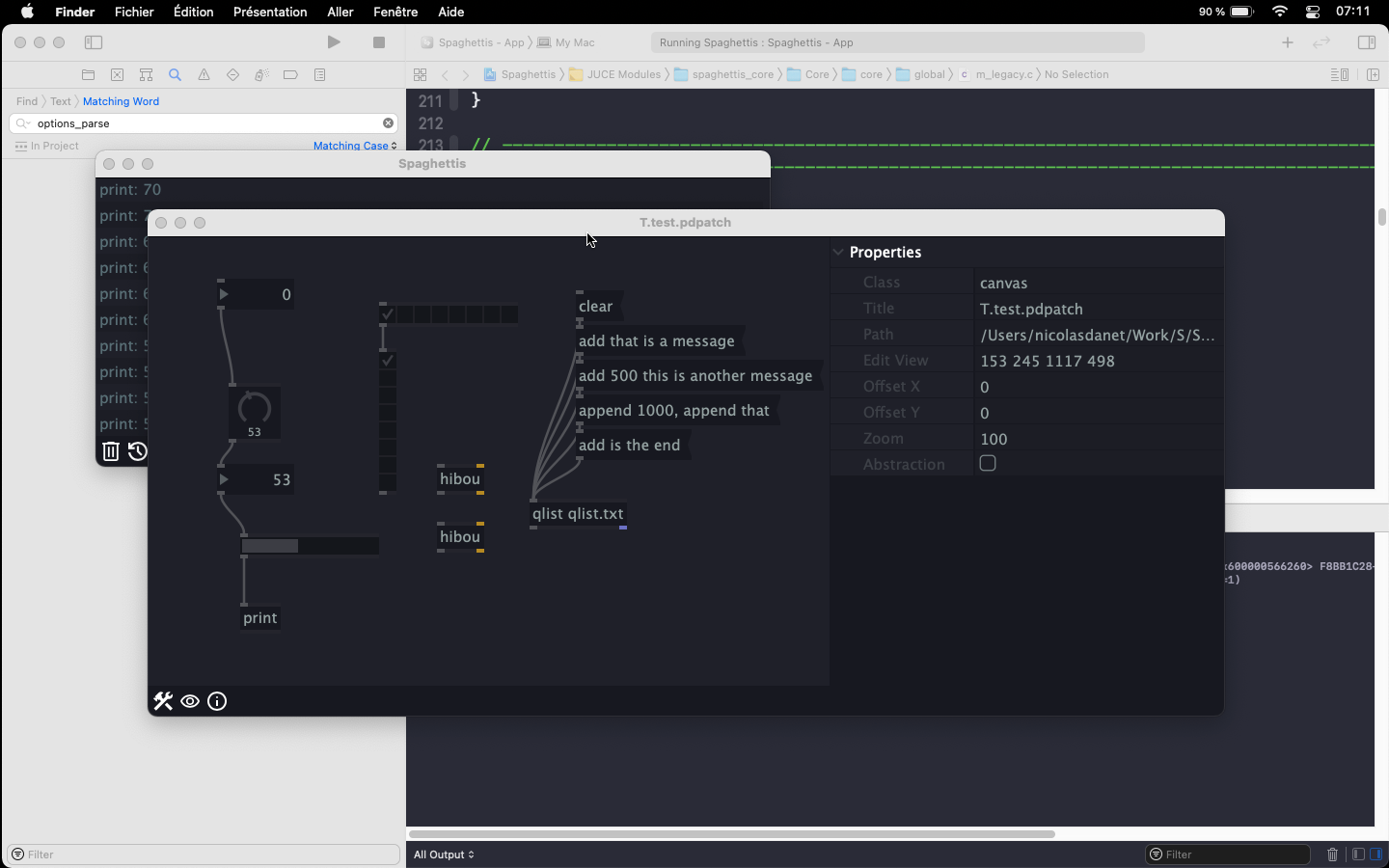
Found following text in chinese (produced by AI i guess -at least my translation-). It's an emphatic mix of truth and garbage (that i found very surprising). It smells marketing bullshit ; and it's hilarious when you compare with the brilliant failure that my project is. 
Spaghettis is an open source audio programming environment based on Pure Data (Pd) deep refactoring and modern evolution, the core goal is not to simply reproduce or fine-tune the Pd's functions, but to carry out a thorough "surgical refactoring" from the underlying source architecture to solve the technical debt, maintainability bottlenecks and real-time defects that have long plagued the Pure Data community. The title "Belling's matlab code - spaghetti", although it is a playful color, it is a metaphor for the opposite of the project such as "spaghetti code" - that is, through a highly modular, separation of duties and thread decoupling, the original winding Pd code system is coaxed into a clear, verifiable, and scalable modern C++ audio system. The name Spaghettis itself constitutes a subtle pun: it ridicules the visual features of the criss-crossing of the patch line in the development of traditional Pd, and announces the project's technical liquidation and structural reconstruction of "noodle confusion".
At the technical level, Spaghettis’ fundamental breakthrough lies in the revolutionary redesign of the real-time audio signal processing (DSP) subsystem. Traditional Pure Data squeezes all GUI event loops, object scheduling, memory management, and audio computations into a single main thread, causing any interface blockages (such as large patch loading, file I/O, or script execution) that directly trigger audio thread jitter, xruns (buffer overload), or even crashes. Spaghettis enforces strict thread isolation: the DSP engine is completely stripped into a dedicated thread that is independent, high-priority, lock-free, and “obsstruction-free.” This thread only responds to operating system-level timer or audio hardware interruptions, and does not participate in any GUI operations, user input resolution, or non-real-time memory allocation throughout the process, thus eliminating the possibility of audio streaming interference from the architecture. This design not only greatly improves the accuracy and stability of audio timing, but also enables Spaghettis to have the deterministic behavior required by industrial-grade real-time audio systems such as professional digital mixers and embedded audio devices, laying a solid foundation for the deployment of complex algorithms under ultra-low latency (sub-millisecond) processing, multi-channel synchronous sampling, and hard real-time constraints.
Further, Spaghettis' philosophy of reconstruction is embodied in the engineering tenet of "subtraction is better than addition". The developer explicitly stated that "simplicity is understandability and consistency", which actively removes a large number of historical, ambiguous or extremely low-use objects and mechanisms in Pd (such as some old GUI objects, redundant scheduling policies, non-standard memory models), and introduce intelligent pointer management in line with the modern C++17/20 specification, RAIDI resource encapsulation, constexpr compilation, and template element programming optimization. This radical streamlining is not a functional regression, but by eliminating ambiguous interfaces, unifying data flow semantics (such as strictly distinguishing control domain and audio domain signals), and standardizing the life cycle of objects, greatly reducing the learning curve and debugging difficulty, so that developers can focus on sound logic itself rather than framework traps.
For future evolution, Spaghettis explicitly plans to fully replace the native Pd’s cross-platform GUI subsystem with the JUCE framework. As the industry-recognized top-level C++ audio GUI toolchain, JUCE not only provides pixel-level controllable vector drawing, native system-level window management and HID device support, but also its built-in VST/AU/AAX plug-in export capabilities. This means that Spaghettis will no longer just be a standalone patching environment, but will become a “plugin factory”: user-written Patch Patch can be automatically converted to DAW (such as Ableton Live, Reaper) standard binary plugins through the Spaghettis compiler backend, seamlessly integrated into professional music production processes. This path completely breaks down the agility of visual programming and the industry standard of professional audio products, and solves Pd the core pain point of "hard to productize" for a long time. Combined with its multithreaded DSP architecture, Spaghettis can even support multi-core parallel audio processing (such as sub-band independent thread processing, spatial audio rendering engine) inside the plug-in, far beyond the capability boundary of traditional single-threaded plug-ins.
In summary, Spaghettis is not a simple branch of Pd, but a systematic dimension for the 2020s audio development paradigm: it uses C++ engineering practices as a rib, real-time protection as the blood, and HUCE ecology as the nerve endings to build a full-stack open source audio infrastructure that connects educational research, art creation and commercial products. Its value lies not only in the realization of technology, but also in the establishment of a new paradigm for the entire interactive audio community - rejecting technical inertia, insisting on the architecture and cleanliness, and the most simple goal of "let the sound reach the ear on time", and sublimate into a rigorous, open and full of vitality software engineering practice.


 I guess you are talking about <
 ) is simply too much pain. Thus consider it officially DEAD. I should have called that thread "The NO future of Spaghettis"!
 <
<