
I'm currently using an oscillator that has high levels of harmonics filtered by several bandpass filters in parallel to generate formants, and that works pretty well. I'm interested in other ways of generating formants. I've seen old references to fof~ and vosim~, but these objects are old and apparently unsupported. Does anyone know of current versions of these? Or other ways to generate formants in Pd?
-
Objects for formant synthesis?
-
There's also the John Chowning "Phoné" FM formant approach, where the carrier is at the formant center frequency and the modulator is at the fundamental. It's "formant-ish" I suppose, but sweeping the fundamental while holding the formant frequency steady does produce a vocal-ish sound.
Here I'm crossfading between two formants, to make smooth transitions between integer carrier-mod frequency ratios.
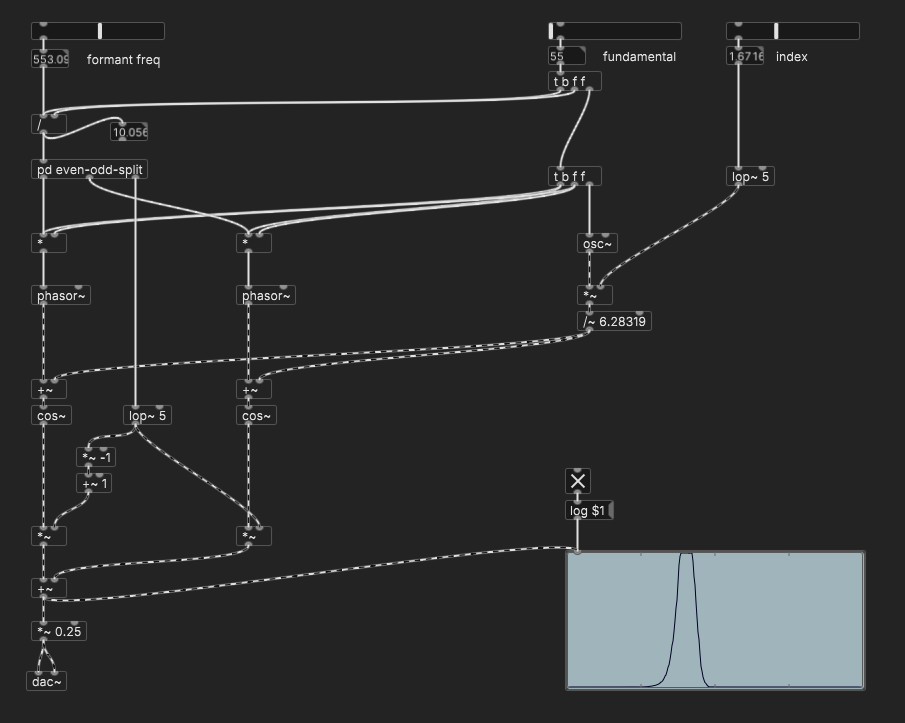
Oops, no:
(~[spectrogram~] is from cyclone -- not essential to the patch's operation.)(~[spectrograph~] is from ELSE -- not essential to the patch's operation.)
hjh
-
@ddw_music said:
spectrogram~ is from cyclone
cyclone does not have a [spectrogram~] object
ELSE has [spectrograpg~] though.
About formant synthesis with FM, I know Miller includes something like that in the audio examples (see F10). Is it related maybe?
-
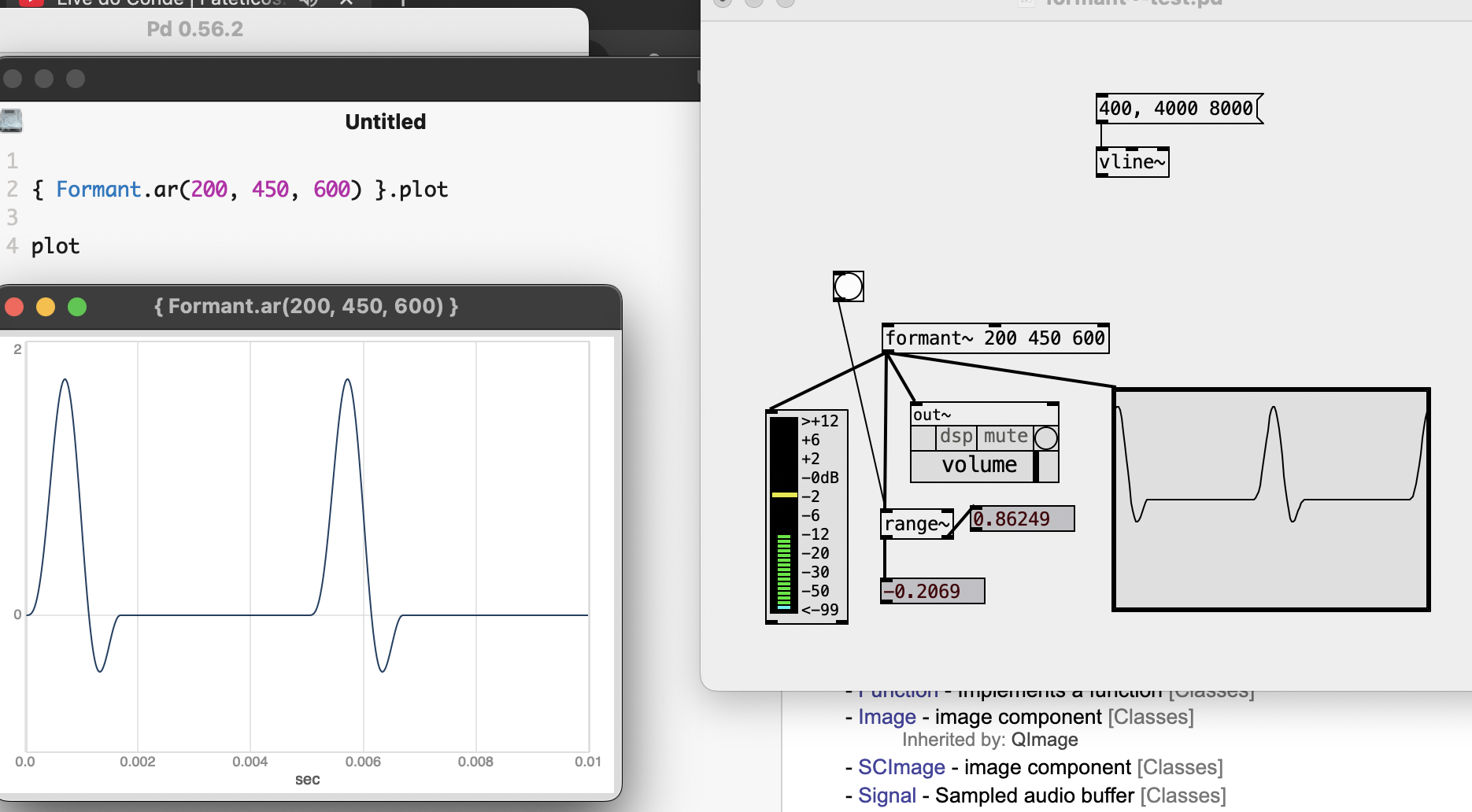
by the way, just implemented SuperCollider's Formant Ugen as a compiled Pd object...
-
For those looking closely, the output scale of SC is bad, range can be from -2 to 2! I fixed it in my external.
-
@porres said:
cyclone does not have a [spectrogram~] object
ELSE has [spectrograpg~] though.
Thanks -- I didn't look closely enough at the help patch.
About formant synthesis with FM, I know Miller includes something like that in the audio examples (see F10). Is it related maybe?
It probably is, and his implementation is probably more elegant than mine (though it's jammed into a small space on the screen so it's a bit tough for me to read quickly).
It takes some tuning -- the FM index isn't a simple analog to formant bandwidth (it seems to need to be scaled down at higher pitches). But it's computationally cheap and gets a useful result, and it seemed to fit "approaches to formants other than bandpass filtering."
hjh
-
@porres I tried the paf~ that solipp linked to, and it seems to be exactly what I'm looking for. How would I get the Windows version of vosim~ from github?
-
yeah, I'm working on a version of that too to incorporate in ELSE. I tried for years to include that into Pd Vanilla and will give it another shot for 0.57, but it's likely I'll redesign and include it in ELSE

For vosim~ just get any recent github actions artifacts from https://github.com/porres/pd-else/actions but you have to be logged in
I now added a version of SuperCollider's Formlet Ugen, but I'm not sure how to use that in this context
-
@porres Thank you!
-
So, how about we discuss all these options and how they relate to each other? Anyone with me?
Let me talk about FOF here... Basically, it's a hard-synced oscillator! And I always thought hard synced oscillators sounded really nice for forcing harmonics into a fundamental pitch, and that's it... Ok, there's more to that of course, and it also passes through a decay envelope, which can be implemented with [rpole~], here's a minimal Pd patch of this main core.... it uses objects from ELSE of course... specially for making hard sync easier. Below, 150 is 'f0' (fundamental), 390 is center/formant frequency, and 100 is bandwidth, all in Hertz...
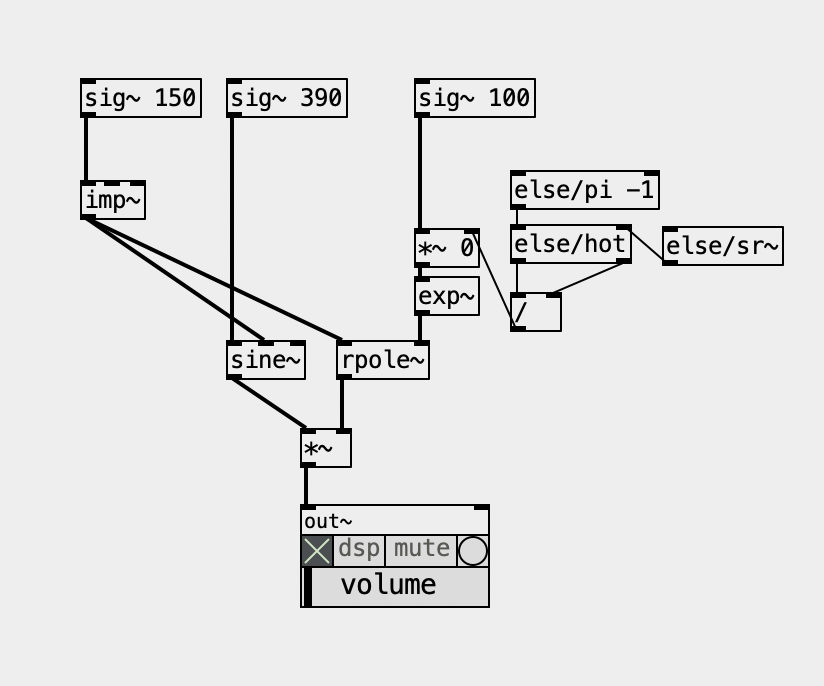
But then, the envelope grain might and can overlap. The Csound implementation is pretty much "Csoundy", ridiculously complicated with way too many parameters and options, not to mention a seemingly inexplicable low output that forces you to multiply it by a ridiculously large and arbitrary number. Besides the decay envelope, it also applies another envelope on top of it, which might be pretty useless when the first envelope simply dies before it, but it can be useful to apply an attack phase. What a mess! The FAUST implementation is simpler and makes more sense!
The Formlet UGen from supercollider implements a filter with attack and decay, and it rings, so you don't need the hard synced oscillator. Plus, it can "overlap" grains quite seeminglessly. It's pretty clever and it made its way back into Csound, where it's called fofilter.
What makes no sense for me is the "BandWidth" parameter in FOF (or using Formlet). In Pd's examples we have the paf like patches and the bandwidth makes actual sense because it represents a bandwidth of partials over the center frequency. In FOF we don't have that
and the larger the bandwidth, the thinner the sound actually is because the decay is faster.Now, i also ported the Formant UGen and this is what it is, basically, as a patch, guess what? Yup, another hard synced oscillator, basically, being enveloped, so... I guess it relates to the Fof approach... but not quite... one way or another, there's no reference in the docs or code of where it comes from and maybe I should ask the SC Forum (again)
Below, BW ratio means the ratio of bandwidth according to the fundamental, so '3' is '150' hz. This parameter to me feels like controlling the "brightness" anyhow.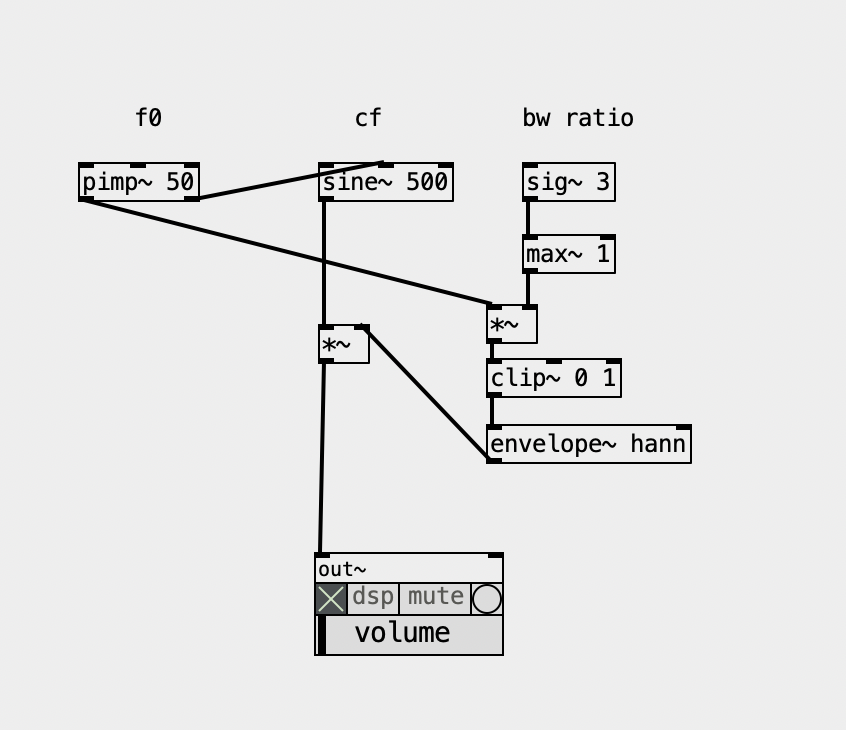
And there are also the FM approach, the paf, the VOSIM, not to mention the filterbank approach... Gosh, what a mess... I guess I know why I procrastinated so much to finally deal with this... but it's time and now I'll map them all and see how they relate to each other. And I'll sort it all out in my Live Electronics Tutorial...
I'm still thinking what are the objects that make sense actually including in ELSE...

