
-
johannem
posted in patch~ • read moreI thought it was time to give an update on what has happened with this project recently.
I rebuilt the core engine of the project and removed a lot of unnecessary stuff. I tested it at several live gigs and also got valuable feedback from two workshops I did with this patch/device.
I moved into custom DSP using Faust for a while, but eventually backed out of it because I wanted the first version to be pure vanilla Pure Data. The custom stuff will follow later.
Most importantly, I redesigned the Modular Grid. There were simply too many sliders for such a small screen. It now looks like this:
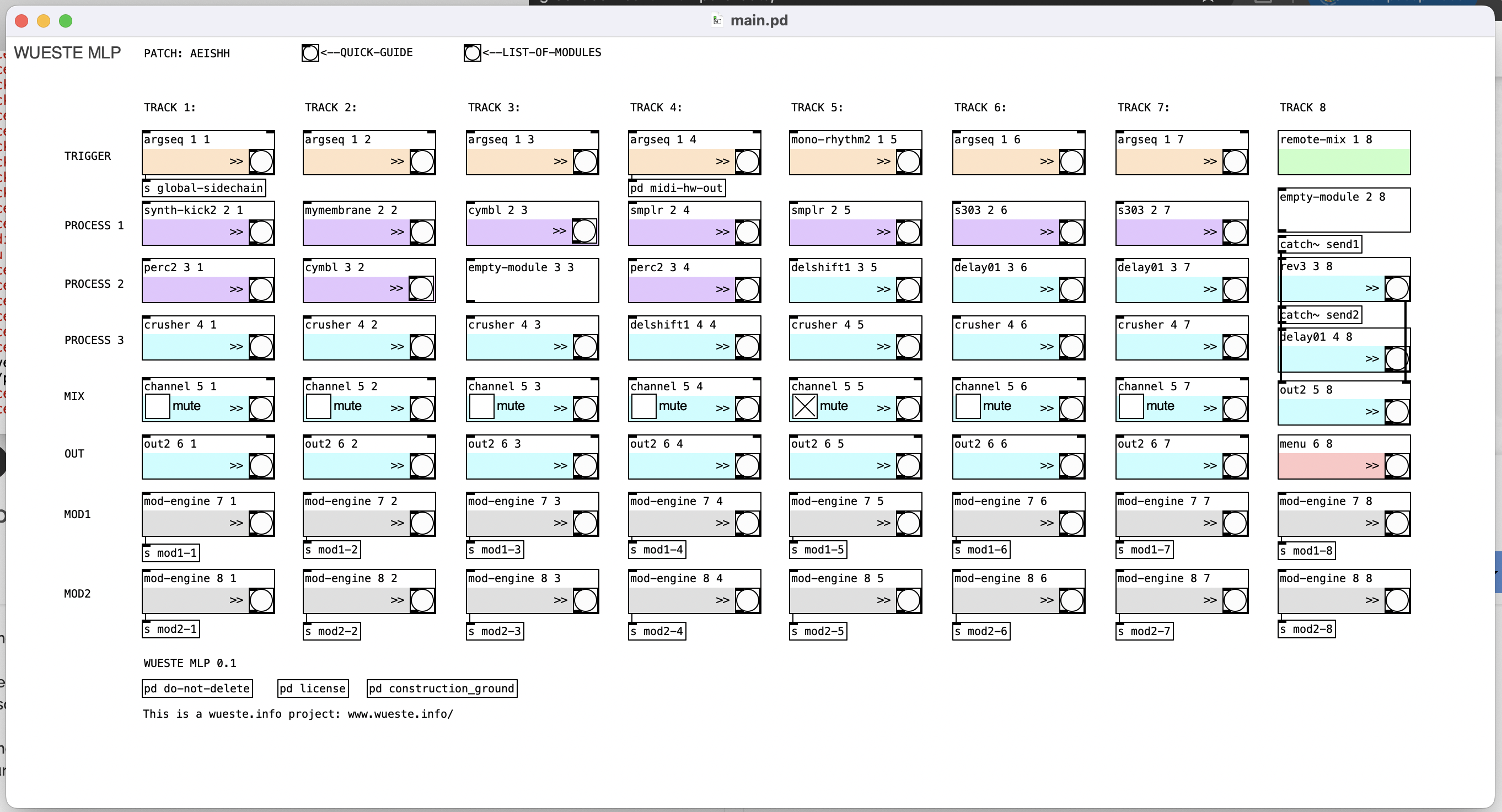
The GUI of each module is now opened by pressing the bang on the respective module.
I also changed the internal module structure. MIDI and audio are now transmitted along each track, from module 1 to module 6.
Modules 7 and 8 are always modulators that are carried across each track.
So basically, each track consists of one Trigger/Source module. This is always the beginning of the chain. At the moment, there are two working modules for this: a 64-step sequencer and an algorithmic sequencer that basically sends rhythmic signals. They are pretty simple, but a lot of fun to play live.
After the Source module come the different Process modules. These can be synths, samplers, or audio/MIDI effects. You can either chain three synth/drum modules together or, for example, add two effects to a synth sound.
After the audio processing, there is a Mix module where you can shape the sound a bit — filter, FX sends, drive, etc. This is followed by an Out module, where you can select which output the signal is sent to. The hardware has eight outputs.
Track 8 works more like a control/master channel, where the FX sends and the clock (called Menu here) are located.
It’s still an ongoing prototype with constant changes, but the ideas are becoming more and more defined.
If anyone is interested in trying it out or building the hardware, please let me know!
-
posted in patch~ • read more
Hey folks, a little progress report since the first post.
The most visible thing: I built a small wooden enclosure, and my son printed some knob caps which we sprayed orange.
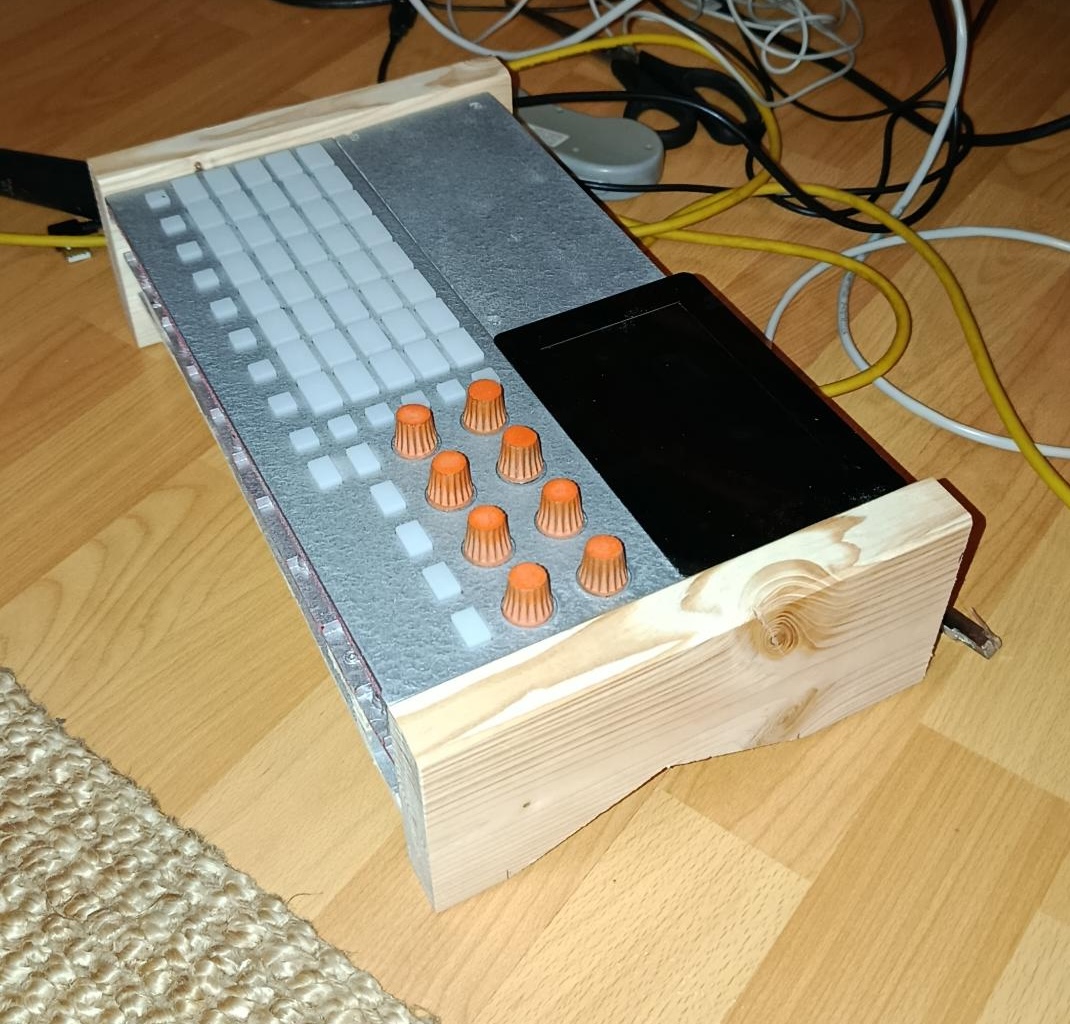
On the software side, a few things have moved:
Pattern copying — patterns can now be copied to other pattern slots during a session.
Chord sequencer → pitch per step — I introduced a separate chord/melodic sequencer but it didn't work the way I imagined. I'm scrapping it in favour of extending the existing 64-step sequencer: each step will carry its own pitch and chord options. Simpler, more unified.
Architecture split (work in progress) — I'm in the process of separating the main patch (sequencing, saving, LFOs, modulation — everything non-audio) from the DSP patch (all the audio modules). The goal is to run them as separate processes/cores on the Pi, which should mean: saving the patch without audio dropouts, and a bit more CPU headroom. The mechanism for loading and unloading modules inside the DSP patch is dynamic patching — instantiating subpatches at runtime. The hope is that swapping modules won't cause significant dropouts, but that's still to be tested. On desktop the DSP will run as a[pd~]subprocess; on the Pi both will be launched as separate instances via the Python shell.
Cheap audio interfaces — tested a few budget Behringer USB interfaces as an alternative to the HiFiBerry. They work well and add a bit of latency, but they're functional — and they're a genuinely accessible way to add audio inputs cheaply.
More soon. Cheers! -
posted in patch~ • read more
Hello everyone,
I've been reading and learning from this forum for a long time, and I finally have something to share back. First of all — thank you. Genuinely. So much of what I've figured out came from threads here, from patches people posted, from questions answered patiently by people who had no obligation to help. This community is one of the reasons this project exists at all.
The dream behind it
I play free improvised electronic music, and for years I tried to solve the same problem with hardware: I'd pick up a groovebox, fall in love with parts of it, and then hit a wall — some feature that was missing, some workflow decision that didn't match how I think musically, some thing I couldn't change. Eventually I always ended up back at the laptop. And the laptop on stage has its own problems — the open screen, the trackpad, the menus, the accidental clicks. I love Pure Data, but I don't love a workstation in front of my face during a performance. I wanted something that felt like an instrument in my hands, not a computer I was operating.
So I started building my own groovebox around Pure Data. I call it WUESTE MLP (Modular Live Performer).
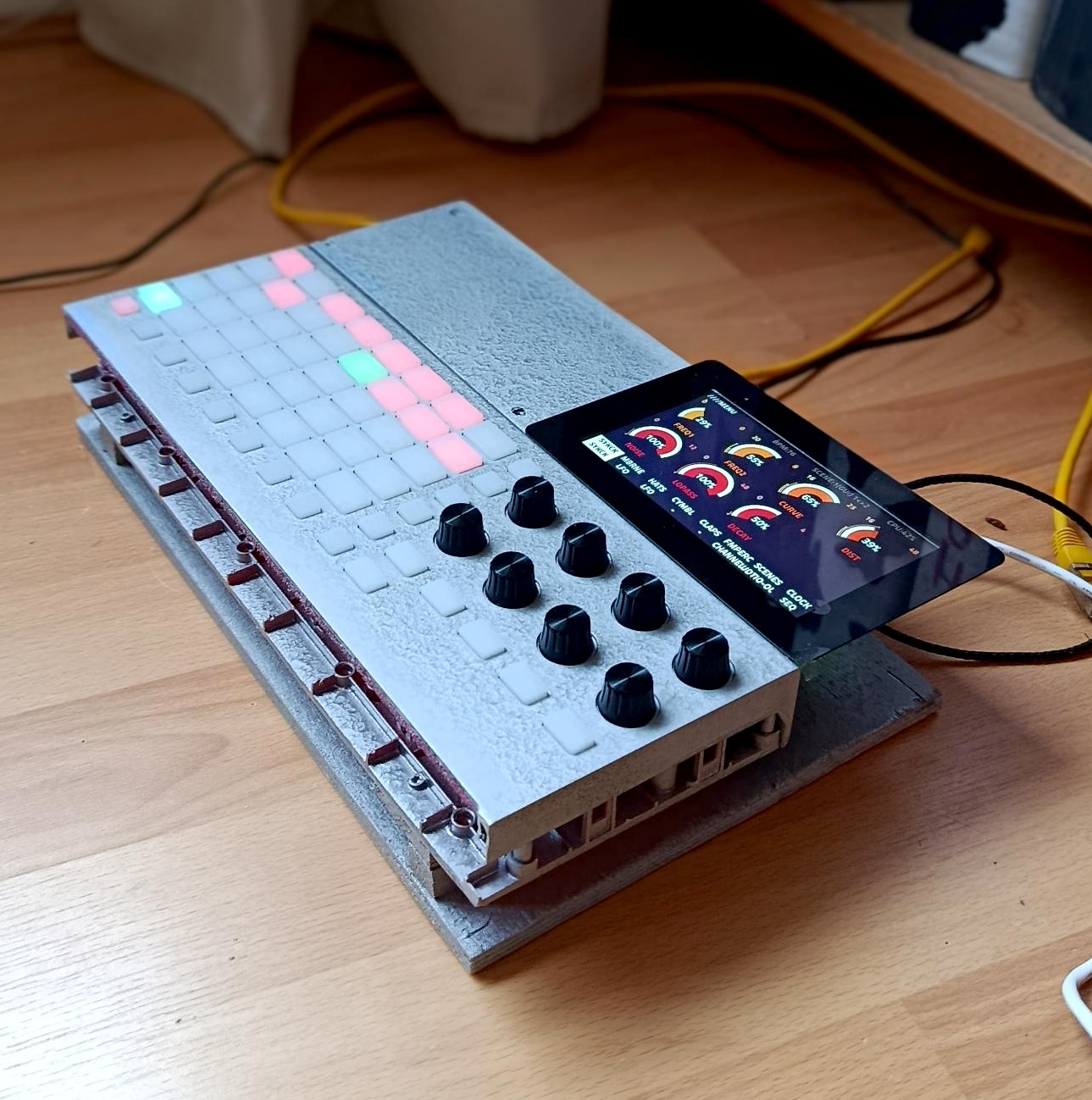
At its core it's a large Pure Data (Vanilla) patch designed like a modular synthesizer — currently with 64-step sequencers, drum modules, LFOs, mixers, and basic effects, all with its own saving and modulation structure. The philosophy is a fixed but modular structure: you design your ideal instrument before the performance, then commit to it in the focused moment of playing. No live patching paradigm — more like setting up a hardware modular, then performing with it.
It runs on a Raspberry Pi 5 with Patchbox OS (huge respect to Blokas Labs for making that possible), a HiFiBerry 8X for 8 audio outputs, and a modified Akai APC Key 25. A custom Python GUI handles everything that normally requires a desktop — loading patches, updating the system, importing from USB — so the performer never needs a terminal or a mouse. The touchscreen is the only interface.
The Pure Data side is the real heart of it. Honestly, the patch is basically a very mutated version of Automatism — I owe a huge amount to that project and to the Organelle ecosystem. Those projects showed me how Pure Data could be turned into a genuinely playable instrument, and MLP grew out of pulling that thread as far as I could.
Where it is now:
This is very much a first prototype but its working. The patches can be tested on any computer with Pure Data Vanilla — just open any main.pd inside the preset_projects/ folder, no GUI needed. So if anyone is curious about the Pure Data architecture, that's the easiest way in.
Codeberg repo: https://codeberg.org/johannkabuye/wueste_mlpMore info: https://wueste.info/tools.html
What I'm looking for:
Honestly, tips. If you look at the patches and see something obviously wrong or obviously improvable, I want to know. I'm not a trained DSP engineer — I've learned by reading, experimenting, and occasionally embarrassing myself in forum threads. If anyone is curious about testing it or wants to follow the development, I'll try to post updates here as things evolve.
Thank you again for everything this community has already given me without knowing it. -
posted in I/O hardware diy • read more
Thanks for the info. I saw some online information about the Sysex control too, just wasn't sure how well it's going to work. But anyway, I'm just going to get a second-hand Push Mk1 for around 100€ and will see how to make use of it. It's pretty cheap considering the amount of buttons, encoders, and the screen.
I'll post here as soon as I find out anything useful.
-
posted in I/O hardware diy • read more
Right now, I am working on a larger patch that is essentially a modification of the Automatism modular synth. At the moment, I am using a Novation Launchpad to control the sequencer, etc., but I would like to use an encoder and have a screen to display graphics, values, and other information. Ideally, I would like to control this display information directly from Pure Data.
I was considering getting an old Push controller from Ableton. I found some information about controlling the display in Max/MSP but haven’t come across anything related to Pure Data.
Short question: Has anyone already tried this and would be willing to share some knowledge?
-
posted in I/O hardware diy • read more
Hey folks,
I build a pure data, raspberry pi drumcomputer/synthesizer. The DAC is a hifiberry with extremely low latency. I used korg midicontrollers and it worked wonderfull. But now I am trying to get into my custom midi controller and start to learn arduino.
I followed this fanastic resource (https://github.com/alexdrymonitis/Arduino_Pd) and also read the Arduino for Pd'ers-Guide which was very good guide an helped setting up a first test. I connected two buttons and it works good but it has a horrible latency. It isn't my soundcard. But it seems that the serial information comes with a delay. Does anyone have an idea?Cheers,
Johann