@Balwyn Eh?
Probably because we don't sign binaries on Windows.
Also: who still uses McAfee? o.O

Dirty pitch control knob
@dreamer please don't take offence, at my age I need all the safety precautions I can get, Anyway I just checked and the whole toolchain business is all intact now so I tried to compile it. the vst has no inlets or outlets or Gui, I guess it doesn't like me 
@Balwyn Oh you need to setup special receive objects to create plugin parameters:
https://wasted-audio.github.io/hvcc/getting-started/patching/
https://wasted-audio.github.io/hvcc/generators/dpf/
@dreamer I have followed the instruction on sites you directed me to and compiled the plugin. I loaded it in vsthost but it doesn't output anything
What do you think is missing?
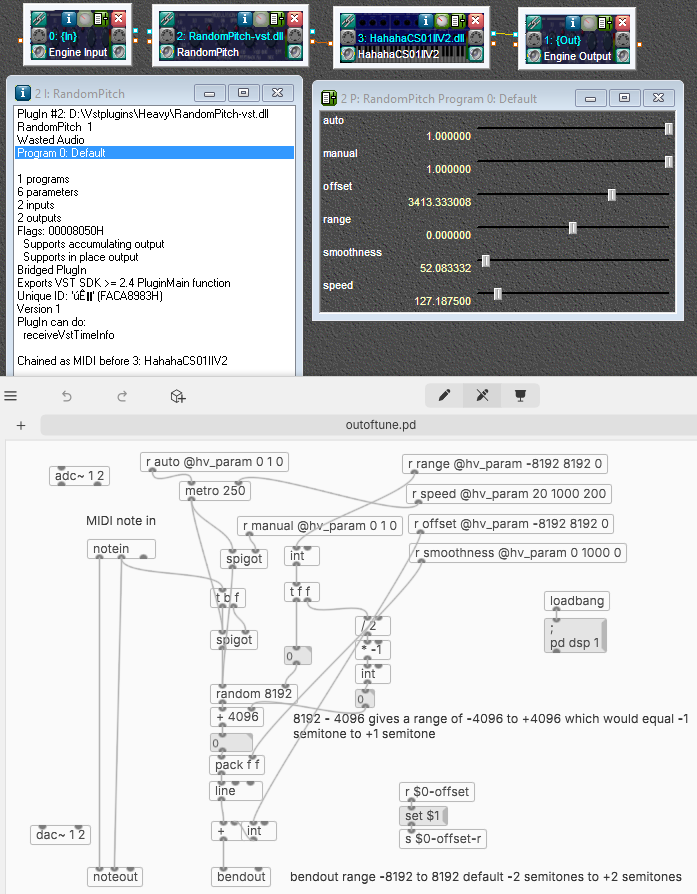
Well, I'm still using the first version, as it's a little easier for me to understand and I'm happy with it, thank you.
I like the fact that PlugData can be used inside of VSTHost. It means I can modify the code within a patch on the fly and hear the effect (if any).
Creating new instances of plugins is easy in VSTHost (right click on plugin - new instance). The set-up below creates a wild harmonising effect.
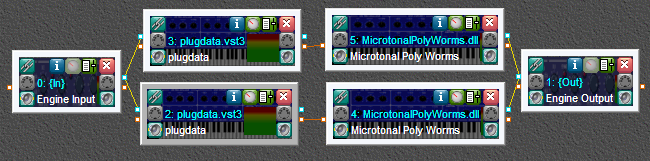
Both synths have the same parameters (doesn't have to be the case) and are both fed pitch bend instructions from two instances of the "DirtyPatch" you created, One almost at minimum setting and the other on max.
How difficult would it be to create a "standard" harmoniser patch (2nds, minor thirds, major thirds etc) with an element of randomisation? It should run alongside DirtyPatch and another instance of the synth (or synth only).
@Orangery I'm not that good on music terminology, but here I've added an hradio of 13 cells that when set greater than zero will also play a note that many semitones above the original at the same velocity
out-of-tune-2.pd
I've just noticed today when you first open the plugdata.vst edit button there is a plug icon to enter plugin mode
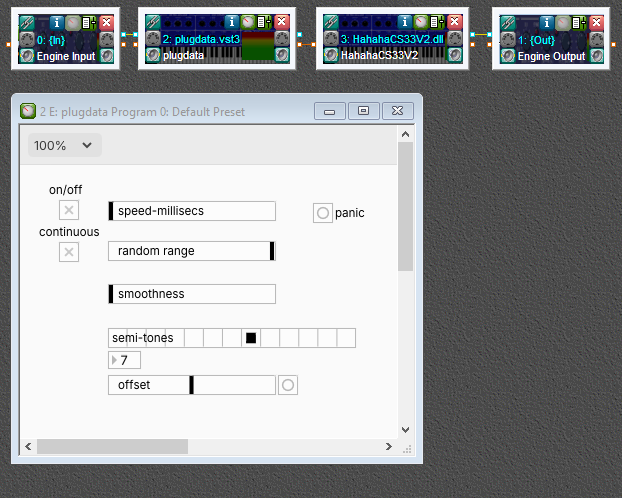
@dreamer Solved, updated plugdata to v0.93 and I think I needed dsp on to run the metro. Anyway thanks for great product 
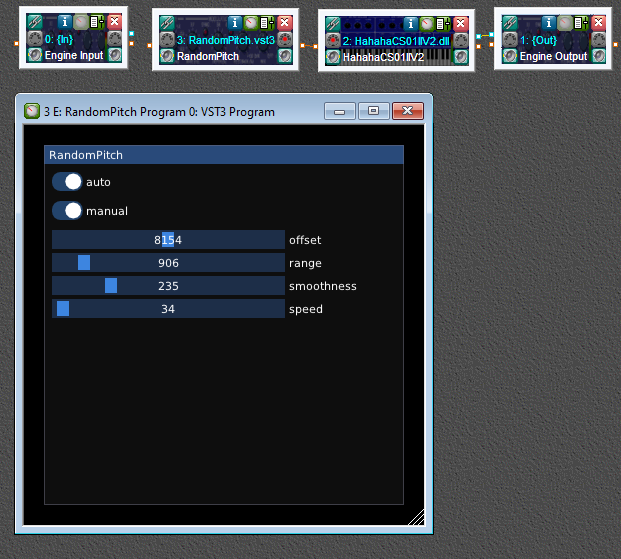
@Balwyn Nice! DSP settings don't do anything in Heavy btw, it's always running (and it's not needed for metro).
Changing to a boolean value for the toggle probably fixed it 
@dreamer I was just checking about the dsp when you posted, and you are right of course Thanks again
The patch works fine but not quite what I had in mind, as the interval is constant (unless I'm not using it correctly).
The idea was to randomly select an interval each time a note is depressed, say from a second to a minor 7th. This would equate to a number from 2-10 on your scale (I miss off 0, 1, 11 and 12 but not essential).
@Orangery try adding these
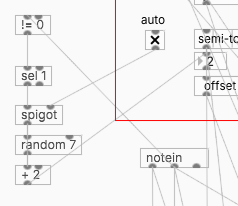
Great, thanks. I changed "random 7" to "random 9" so it covers numbers 2 through to 10. The numerical values change but they do not affect the output notes (intervals are constant). Maybe I have got something wrong (the new auto toggle switch for example)?
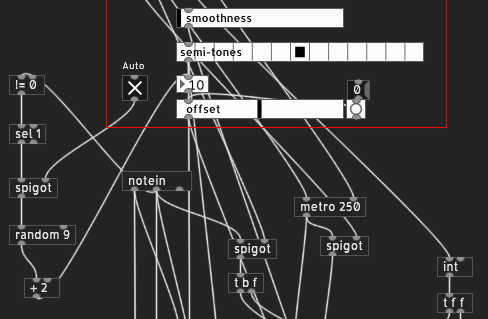
@Orangery Yes, sorry about I hadn't tested it and the numberbox outlet was not connected to the [+ ] object, but worse than that was the random notes cause some notes hang when playing more than one note if playing polyphonically. The best I could come up with to address that, was to count the note-on and note-off and when sum was zero perform an all notes off (cc 123).
out-of-tune-3.pd
Thanks very much for sorting it. The patch works really well with some microtonal tunings. My intention was to record some miniatures to demonstrate its usefulness but Audacity is giving me a hard time at the moment (something to do with my VSTHost set up).
Replacing "random 9 /+2" with "random 9/-11" produces a different harmony. as the randomly generated notes are now an octave lower. So for example, C3, E3 would become E2, C3.
Oops! Looks like something went wrong!